A Providential Encounter
It all begun with a random text message sent by my mother on November 28, 2024. A simple photo of a book she found while visiting her sister, Albine, my Godmother.
That book? Thérèse Durnerin, Founder of the Society of the Friends of the Poor (December 31, 1848 - April 7, 1905), by Monsignor Laveille.
It is important to mention the author, as Monsignor Laveille (1856-1928), was not some kind of unknown biographer, many will soon refer to him as the “official painter of our Catholic Glories”, as he wrote among many other books (Life of St Louis-Marie Grignion de Montfort, Life of Madame Carré de Malberg, fondatrice de la Société des Filles de Saint-François de Sales, Life of Abbe Henri Chaumont, fondateur de la Société des Prêtres de Saint-François de Sales[1]…), the first biography of Cardinal Desire Mercier, and the first biography of St. Thérèse of Lisieux (Definitive biography, commissioned by the sister of St. Thérèse).
I thought important to mention it as Cardinal Mercier took Blessed Dom Marmion as his confessor, and many know how important the writings of Blessed Dom Columba Marmion are to any disciples of St. Francis de Sales. It is our hope to see them both, the Cardinal and Blessed Dom Marmion, one day, proclaimed Saints by Mother Church.
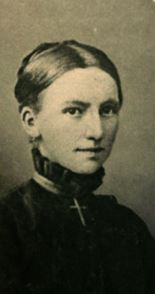

Another biography which I found later, was written by Henri-Marie Hamez in 1908, who received a letter signed by Cardinal Mery Del Val (author of the Litany of Humility), in the name of Pope Pius X, congratulating him and encouraging him to promote his book.
Curious about this mysterious Thérèse Durnerin, I decided to purchase the book and to read it. In the meantime, I did some research regarding existing connections between her and my mother since both have the same last name (my mother’s maiden name is Durnerin). At my great surprise, neither my mother nor my aunt did seem to know anything about her.
After some investigations, I realized that Thérèse Durnerin was no other than my great great grandfather’s sister, that she was never married and was at the time, a well-known French mystic. Her fame in a way, fell into the cracks of history, certainly due to the fact that her own great grandfather, Marc-Etienne Quatremere[2] is an important figure in the family, certainly an unofficial “martyr” who was executed, on January 21, 1794 one year exactly after King Louis XVI, by the hands of the same tribunal and for only motives: His catholic faith, his charity for the poor and his hatred for the Revolution. M. Quatremere seems to have obscured the humble presence of Therese over the years. But as in the life of many saints, they often wish to disappear in order to reappeared at the opportune time!
[1] Benedict XV had Cardinal Gasparri write to the author: This book is a work of apostolate, from which all priests who aspire to perfection in their state, and have the ambition to make their lives fruitful by extending the reign of Christ, will be able to greatly benefit. Yes, certainly, it is highly desirable that the life of the priest be a life of prayer as well as action, and that study be considered by all as the indispensable auxiliary of the ministry, especially in the present era. It is the spirit that is everything, even in external works. The example of your hero, so well highlighted by you, will certainly make many young evangelical workers reflect, who seem to expect everything from what you very rightly call "excessive external action". (cf. Monseigneur Laveille, 1856-1928, by Laveille, Eugène (1871-1941))
[2] Official condemnation from the Revolutionary Tribunal: “Quatremere, known for his incivility and his devotion to the cause of tyranny and fanaticism, saw in the functions that were deferred to him only the opportunity to serve his hatred for the Revolution”. The president of the Tribunal declared that "Quatermère, in his charity for the poor, had only his God in mind and not the sans-culottes (Partisans of the Revolution), and that he deserved death for having humiliated the people by his kindnesses."
*
That same month of September, I was asked to approve the use of a small prayer book by our local chapters of “Sisters”, which I did without paying much attention to every page. More than 5 months later, one of the “sisters” approached me and showed me one of the very first prayers which this book contained, which was a prayer written by Thérèse Durnerin, and which St. Thérèse of Lisieux, had herself memorized and asked all her Carmelite sisters to memorize and recite every day as we can read in several biographies of the Saint. You can only imagine my stupefaction when realizing how all these events and signs were coming together, as if my new friend Therese, was finally getting out of her sleep to continue a work she had left 120 years ago, for the sanctification of priests now through the Seven Sisters Apostolate.
Among her faithful correspondents was a priest who has, as many know, a very special place in my heart particularly when it comes to the formation and sanctification of youth: Don Bosco, the Vincent de Paul of modern times.
He will one day write in a letter addressed to Thérèse:
Our
Salesian priests will be happy to lend their contribution to the
dissemination of the beautiful prayers that you spread and which, I
hope, will contribute to ignite the earth with the fires of Divine Love.
We will therefore happily receive the ones you judge about sending us.
May the adorable Heart of Jesus protect your Work and spread it more and
more. For it and for you, I ask the Lord for his best blessings. Your
most humble servant in Jesus Christ.
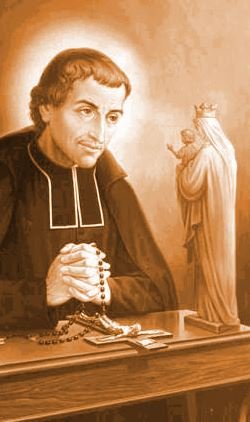
Thérèse will set the foundations of her apostolate for the sanctification of priests, on the writing of St. Louis Marie Grignon de Montfort.
Her biographer wrote; “towards the beginning of the 18th century, a fiery apostle, Blessed Grignon de Montfort, had himself asked God, through Mary, for a legion of holy priests to remedy abuses comparable to those unfolding before Thérèse's eyes, and one of the most ardent prayers ever to pass through human lips had then sprung from his heart. Thérèse discovered it and immediately undertook to distribute it, along with the Eucharistic pamphlets and brochures, in thousands of copies. Moreover, she thought of soliciting novenas of this supplication from souls interested in the priesthood, which she called "The Fiery Prayer of Blessed Grignon de Montfort."
Accomplish,
Great God, your most divine work; gather, call, assemble from all the
places of your dominion your elects, to form of them an army against
your enemies.”
Here are some of the emphases she placed, following the great missionary, on the lips of those who, at her request, begged God for legions of holy priests (translated from the French, Une Hostie Vivante, Hamez):
"Memento! Lord, remember! It is time to do what you promised. Your divine law is transgressed, your Gospel ignored, your religion abandoned, torrents of iniquity flood the earth and sweep away even your servants. The whole earth is desolate, impiety is on the throne; your sanctuary is profaned, and abomination is even in the holy place. Will you thus leave everything abandoned, just Lord, God of vengeance?... Will you then always remain silent?"
What do I ask of you? priests free from your freedom, detached from everything, without father, without mother, without brothers, without sisters, without relatives according to the flesh, without friends according to the world, without possessions, without burdens, without cares, and even without a will of their own.
Slaves of your love and your will, men after your Heart, who, without their own will to defile and hinder them, do all your will and overcome all your enemies, like so many new Davids, the staff of the Cross and the sling of the Holy Rosary in their hands.
People always at your hand, always ready to obey you, at the command of their superiors, like Samuel; always ready to run and suffer everything with you and for you, like the Apostles.
True servants of the Blessed Virgin, who, like so many Saint Dominics, go everywhere, the shining and burning torch of the Holy Rosary in hand, barking, like faithful dogs, against the wolves who only want to tear apart the flock of Jesus Christ; burning like fires and illuminating the darkness of the world like suns; and who, by means of a true devotion to Mary, that is, interior without hypocrisy, exterior without criticism, prudent without ignorance, tender without indifference, constant without frivolity, crush, wherever they go, the head of the ancient serpent, so that the curse you have given it may be fully fulfilled.
Accomplish, Great God, your most divine work; gather, call, assemble from all the places of your dominion your elects, to form of them an army against your enemies.”
*
Although I never had any particular devotion to Saint Louis Marie, I quickly realized this year that without knowing it, through the invisible hands of Thérèse, I had established a special friendship with the Saint.
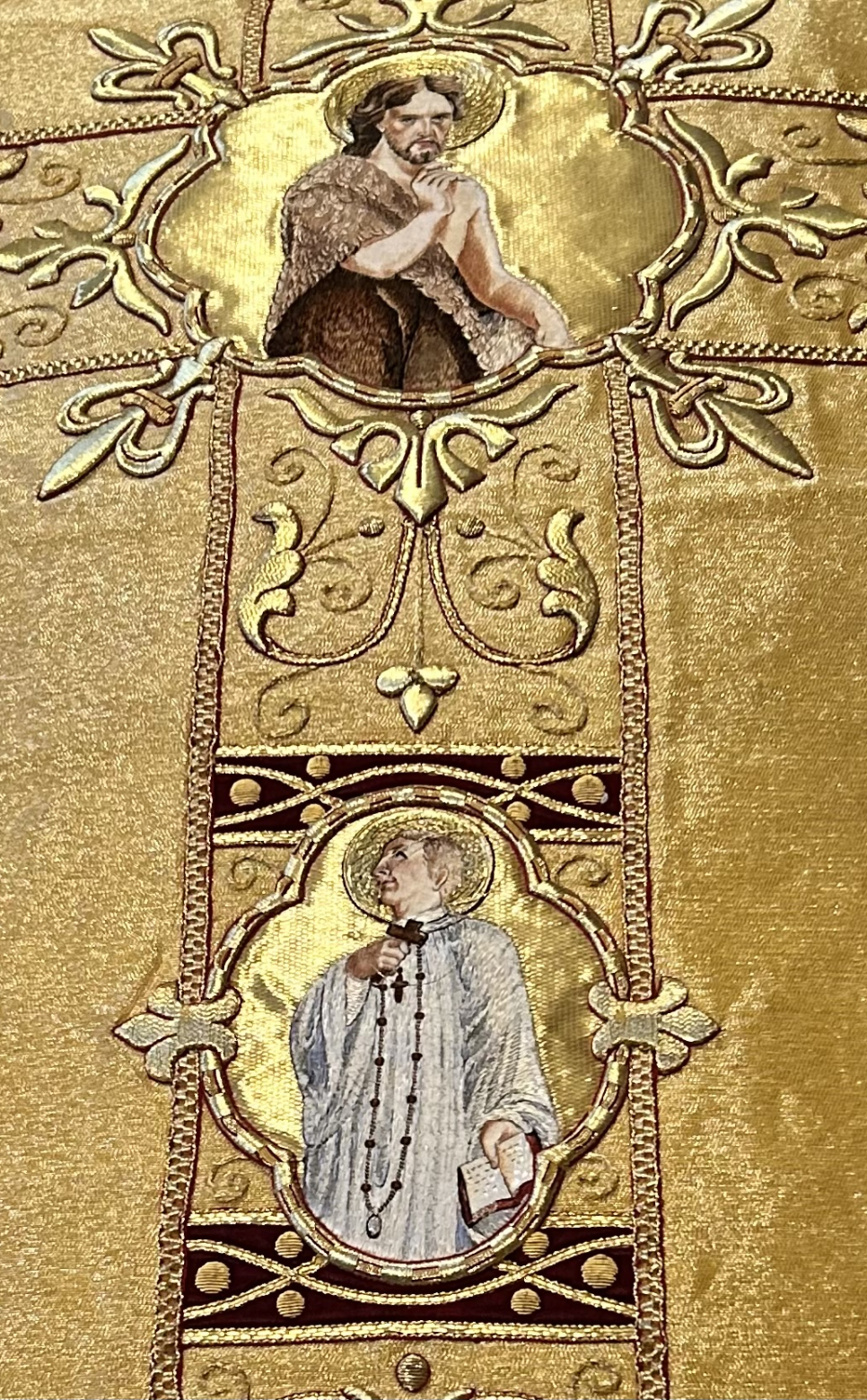
As if all this was not surprising enough for me, I remembered that his image was on my ordination chasuble, which an Institute Canon gave me while at the seminary,because it had a beautiful embroidery of Saint John the Baptist, my patron saint, but also because the quote I picked to be on my ordination card, along with the image of the Sacred-Heart, was from Saint Louis Marie, only because I cherished very much this invocation: O Lord, give us many holy priests and religious vocations, prayed every day by many priests in front of the Blessed Sacrament.
(The two embroidered medallions)
"Lord, God of Goodness,
remember your former mercies. Remember the prayers of your servants for so many
centuries, their vows, their sobs. Remember, Lord, the Blood of your Son. Lord,
give us holy priests, free from your freedom, detached from everything, slaves
of your Love and your Will.” St. Louis Marie Grignon de Montfort.
If I wished to share these few thoughts and findings with you, dear flock, it is not only to show you how Providence acts in mysterious ways, as you certainly know, but also to encourage you to continue to pray for the sanctification of priests, maybe in promoting the beautiful Apostolate of the Seven Sisters, a simple and yet powerful way of practicing the Communion of Saints, or any other form of apostolate for vocations and priests.
And I wish every priest in the world could have a small army of dedicated souls, who would offer an hour of adoration every week or any other form of prayers and adoration, for his intentions and his sanctification, as well as for all those unfortunate priestly souls who have left the most beautiful of all vocations, and God knows how many there are today.
Know that your priests continue to pray and offer the daily sacrifice of a life of immolation for your sanctification and for the expansion of the Rights of God, through his Most Sacred-Heart.
United in prayers during this Holy Season,
Rev. Canon JB Commins
A few quotes from Thérèse
(translated from French)
On the Sacred Heart:
“Yes, she said, you can find him there and honor him. Then she adds, letting, as usual, speak Jesus Christ: "O I seek my heart everywhere or your piety will inspire you to honor me, wherever the attraction of my grace will take you, either by leaning towards the poor and the sick, under whom I readily hide to receive your services and charitable alms; or by working in the great Catholic works, which are the leagues of my soldiers fighting for my service; or in the family that I want to raise, by teaching everyone, fathers, mothers, children, that I am the true father And the friend of each of them; that I want to sanctify the family by living in each of its members, which has become my living host by very frequent communion. But above all Jesus Christ answers with urgency: Where do you find my heart? Isn't it in the Host that I reveal myself in the most excessive way and that you discover the sky and the Jesus of heaven?”
On the sacrament of Penance:
“Believe it is the heart of a God all passionate for you! Don't hesitate for a moment! Here is that my angels prepare you, at the sacrament of penance, a fragrant bath to delight your painful soul. Instead of your repulsive clothes, they put you on clothes that I prepared for you on Calvary, when my sacred body was torn! Then come and sit at the banquet of my Eucharist. Open this mouth that I want to sanctify by my host. Lean on my breast, during the meal; and there, listen to the tenderness that I will whisper to your delighted soul, distraught with gratitude and recognition!”
On the Priesthood:
"Be crucified Christs, priests of Jesus! Like him, offer your blood, your tears, your spiritual and physical sacrifices to regenerate souls and to be their redeemers. You understand that they are guilty, that they have a lot to expiate for. Be their supplement, for one is needed to complete the Passion of Christ. The sacrifice of Jesus lacks that of his creatures; priests, religious, faithful, all are invited to reproduce him in them, to varying degrees and according to the intimate call of grace. But there is an undeniable fact, namely that the priest must always be a Victim Host. Divine Blood flows too abundantly in his veins so that his life is cannot but be marked by the seal of the Cross.”
A short biography from Rev. Canon P. Blanc
I have read few biographies as engaging, and especially as edifying, as that of Miss Thérèse Durnerin. It is a continual miracle that this frail existence, always on the verge of extinction, sustained by a visible intervention of Providence, which chose such a fragile instrument to accomplish admirable works. I will pass over in silence the account, thrilling with interest, of Thérèse's early years. We find her, at the age of twenty-three, on a bed of pain: she will remain there for ten years. Her mission as a living host has already begun; she is about to inaugurate her mission as an apostle: both will consume her until her last breath.
The anemia of her limbs in no way weakens the courage of her heart. Unable to stand, she finds the strength to work for the missions, for the poor, and especially for souls. When her failing hand does not hold the needle, she takes up the pen, and the lines she traces seem dictated by a seraph. Her fiery soul passes entirely into her writings, and communicates to the reader the ardor that consumes her. The Eucharistic Heart of Jesus is the ordinary theme. She does not address herself only to the faithful: the sanctification of the priest is the dearest objective of her zeal. The grandiose idea she conceived of the priesthood inspires sublime tones when she addresses the ministers of the Lord, or when she urges sinners to come and seek from them the grace of reconciliation. She distributed by the thousands in religious communities and among pious people copies of the fiery prayer of Blessed Grignon de Montfort, to obtain that Our Lord grant holy priests to His Church.
A small oratory, installed near her room and dedicated to Our Lady of Lourdes, became the hearth where the fire that consumed her was constantly fanned.
Still in the same state of physical helplessness, she undertook a Eucharistic crusade, intended to arouse within the Church a supernatural surge of love, reparation, and ardent supplications to the Heart of Jesus in the Blessed Sacrament. The modest sheets she sent, by the hundreds of thousands, would carry the echoes of her zeal as far away as Asia, America, and Australia.
Favored by supernatural insights, Thérèse knew that, in the designs of Providence, this crusade of prayers would result in the creation of a new work, which would be like a remedy, prepared by the Heart of Jesus, to heal the most ulcerated wounds of society.
What would this work be? Thérèse did not know: Providence would reveal its designs to her by having her carry them out.
On May 24, 1890, the eve of Pentecost, after receiving communion in her room, Thérèse received from Our Lord the order to rise and leave. However, she was not cured: she was only breathless; and in this sickly state, she began an apostolate that would last fourteen years, the toil of which would be enough to exhaust the most robust constitution.
She visited the poor, evangelized them, and catechized them in their homes; she brought them to Mass and the sacraments, and gathered them in groups at various centers, where holy priests and holy religious, to whom she had instilled the zeal that inspired her, came to offer these souls, until then so neglected, all the spiritual help they needed.
Every year, Thérèse would spend a few days in Lourdes, to reinvigorate her soul at the feet of the Blessed Virgin. She would never return with bodily health; but she would always return more valiant. However, she might be lavish: alone, she could not suffice for the work she had undertaken: she needed helpers. Providence was quick to provide them; and, little by little, in the midst of a thousand difficulties, despite obstacles, contradictions, I would even say persecutions, a new congregation was founded in the heart of the capital, dedicated to the apostolate of the poor, the workers, and all the disinherited of society.
A simple consecration, generous nonetheless and total, will take the place of profession, and simplicity in dress will be the entire religious habit of its members. Thérèse will form them in her image: the rules she will lay down for them, the pressing exhortations she will address to them, will aim to reproduce in them the ideal she has previously realized in herself in such a striking way. By the death of the self, and union with Jesus-Host, received each morning at the Holy Table, they must be, as it were, transubstantiated into this divine model. As living Hosts, they will carry him within them: in their features, Jesus will reveal himself to the poor; through them, he will give them his word, his consolations, his Heart.
It is the Blessed Virgin who will initiate them into this spirit of immolation and apostolate: they will give themselves totally to Mary, to be, through her, changed, transformed into Jesus. Ecce ancilla Domini of the august Virgin will be their motto, the characteristic of their life: they will call themselves the Servant Brothers and the Servant Sisters of Jesus. Devoted souls, whose duties of state prevent them from devoting themselves to the work, will be able to join it as auxiliaries or as friends of the poor. This last title will give its name to this entire spiritual family, as modest as it is valiant: it will be called: the Society of the Friends of the Poor. How touching is the story of its beginnings! How edifying these conversions, true miracles of grace, by which Our Lord rewards and encourages the early labors of Thérèse and her devoted auxiliaries! These interesting features are not the least of the work's charms. But the soul finds above all very substantial nourishment in the spiritual doctrine of Thérèse: it is she who speaks in the numerous extracts that the author gives us from her writings; and her words always bring light to the intelligence and warmth to the heart; the supernatural spirit that dictated these pages communicates itself to the reader as if without their knowledge.
Finally, a great lesson emerges from this life marked by heroism: crucified souls, truly dead to themselves and to the world, are the most capable of serving God's great designs; and the most fruitful apostolate is that which is enriched by prayer united with suffering and the spirit of immolation. Is this not, moreover, what Jesus wanted us to understand with this parable: "Unless a grain of wheat falls to the earth to die, it remains alone; but when it dies, it multiplies abundantly." This is the secret of the wonders accomplished by Thérèse Durnerin: her life was nothing but a continual death, and this was the very reason for her fertility.
P. BLANC (1908)
Honorary Canon of Versailles
(translated from French)
HERITAGE OF HOLINESS
Historic Renewal